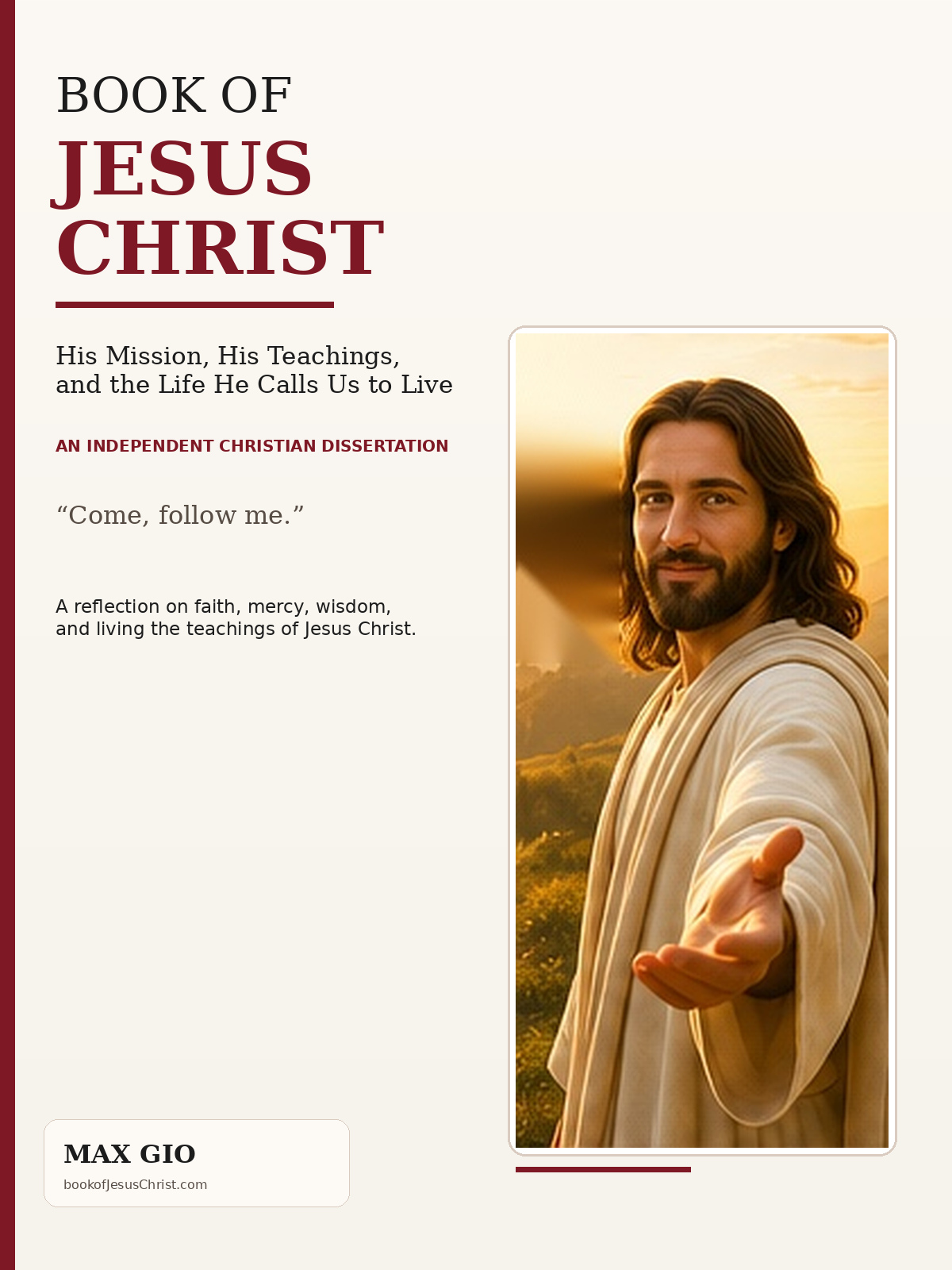
Max Gio writes as a lay Christian whose faith has been shaped over many years by Scripture, prayer, family life, teaching in church settings, questions, mistakes, and reflection.
This is an independent, non-denominational personal work. It is offered with a simple hope: that readers will look more closely at Jesus Christ and carry something useful into ordinary life.
Max Gio
Signs of the Times — Watchful Does Not Have to Mean Frightened
Jesus taught watchfulness, but Christian readiness is not the same thing as panic. This section looks at uncertainty, conflict, lying, and rapid change through the steadier habits of faith, service, courage, and hope.
How This Dissertation Can Help
Look more closely at the mission and teachings of Jesus Christ.
Strengthen faith without turning away from difficult questions.
Bring more forgiveness, patience, courage, and service into ordinary life.
Face uncertainty with watchfulness rather than fear.
Full Dissertation
Read, Reflect, and Draw Your Own Conclusions
The full dissertation continues below in a single, comfortable reading column. Use the chapter links to move directly to a topic.
01 · Why Jesus Christ still matters
Knowing Christian language is not the same as becoming Christlike
“Jesus Christ the same yesterday, and to day, and for ever.”Hebrews 13:8 · King James Version(Jesus Christ is the same yesterday, today, and forever.)
For roughly two thousand years, people have prayed about Jesus, argued about Him, written about Him, worshiped Him, doubted Him, and tried to understand what His life means. Some readers come with settled faith. Others arrive through history, grief, curiosity, family tradition, or questions they have never resolved.
I write as a believer, but also as someone old enough to know that familiarity can become a hiding place. We can know the stories and repeat the right words while keeping them safely away from the parts of life that most need to change.
That is why I wrote this. Religious conversation can become crowded with institutions, labels, personalities, and arguments until Jesus Himself fades into the background. I wanted to return to the Gospels and ask simpler questions. What mattered to Him? Who drew His attention? Where was He gentle, and where was He uncompromising? What did He expect from people who wanted to follow Jesus?
Those questions remain relevant because human nature has not changed as much as our technology has. We still wrestle with pride, resentment, greed, fear, loneliness, status, family conflict, hypocrisy, injustice, and the desire to be seen as right. Jesus spoke directly to many of those struggles.
“I am the way, the truth, and the life.”
John 14:6 · King James Version
The purpose of these pages is not to win an argument about Christianity. It is to ask whether looking more steadily at Christ can help us live with greater truth, courage, love, hope, and peace.
02 · A brief note about His name
Why this dissertation uses the familiar English name “Jesus Christ”
“Thou shalt call his name JESUS.”Matthew 1:21 · King James Version(You shall call His name Jesus.)
Jesus, Yeshua, Iēsous, and Christ
In the first-century Jewish world, the personal name we know in English as Jesus was likely spoken as Yeshua, a form related to Yehoshua. The Greek New Testament renders the name as Iēsous. It later passed through Latin and eventually into English as Jesus.
This kind of language change is normal. We do not ordinarily insist on calling Moses Moshe, Isaiah Yeshayahu, John Yohanan, or Peter Kepha whenever we speak about them in English. Names move between languages, and pronunciation and spelling often move with them.
Christ is a title rather than a family surname. It comes through the Greek Christos and corresponds to Messiah—the Anointed One. Throughout this dissertation I use Jesus Christ, the familiar English form, while recognizing the Jewish and linguistic history behind His name.
For the linguistic background, see the Cambridge and Bible Odyssey references in the source section below.
I do not think a Christian needs to be anxious about using the English form of His name. The more important question is whether Jesus Christ is shaping the way we live.
03 · His mission
Jesus did not present His life as a search for comfort or status
“For the Son of man is come to seek and to save that which was lost.”Luke 19:10 · King James Version(The Son of Man came to seek and save the lost.)
The Gospels present Jesus as teacher, healer, servant, Messiah, and Savior. Again and again, His ministry turns toward people who are suffering, burdened, sinful, excluded, confused, or spiritually hungry.
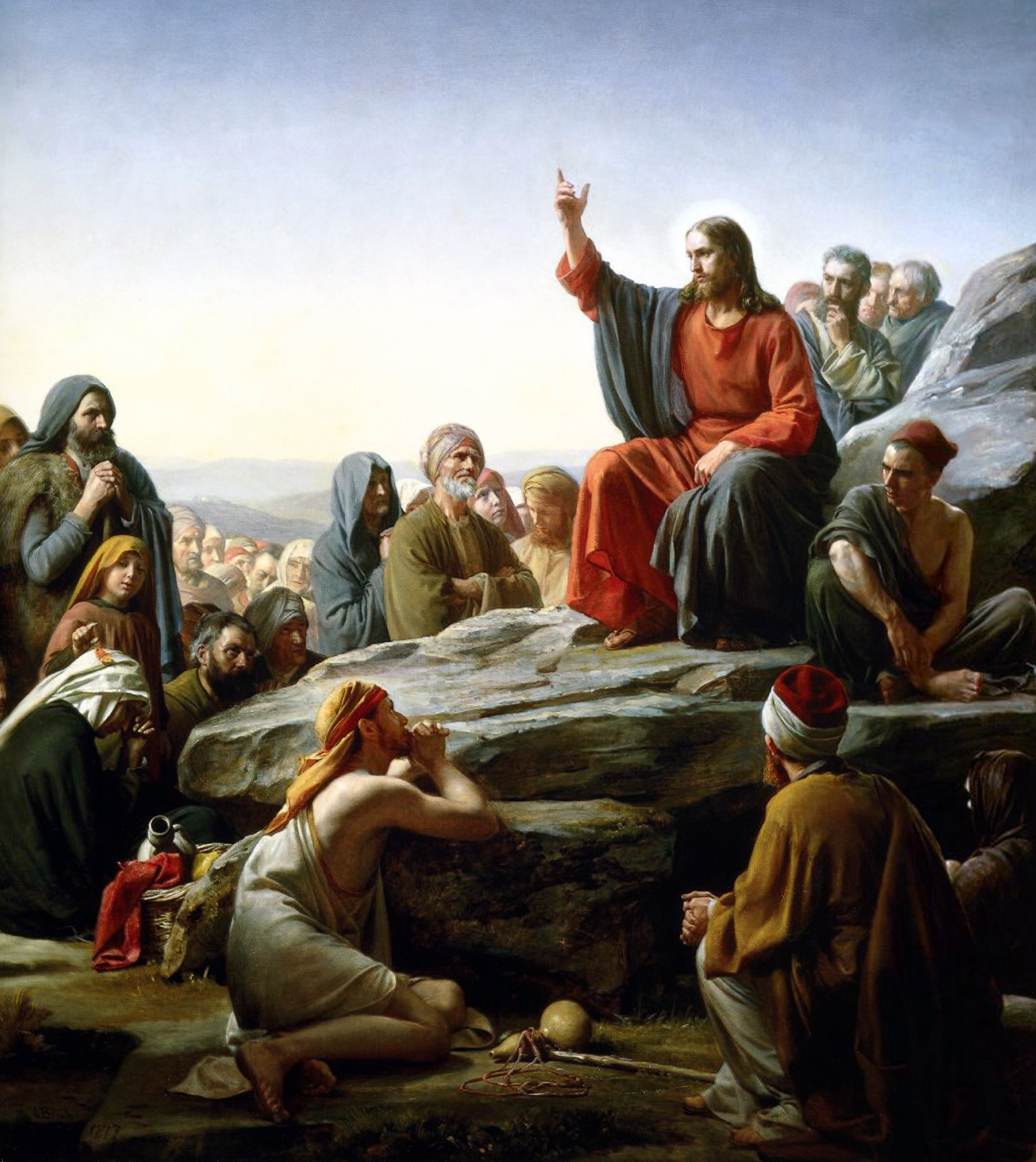
Carl Bloch, The Sermon on the Mount (1877), public domain. Jesus teaches a gathered crowd.
In Nazareth, Jesus read from Isaiah and spoke of good news to the poor, healing for the brokenhearted, liberty, recovery, and release. Whatever theological meaning a reader brings to those words, they do not describe indifference. They describe movement toward people in need.
“He hath sent me to heal the brokenhearted.”
(He has sent me to heal the brokenhearted.)Luke 4:18 · King James Version
His mission also leads to the Cross and Resurrection, which stand at the center of Christian hope. Christianity is not merely admiration for an unusually wise teacher. It makes a much larger claim about who Jesus is and what His life, death, and Resurrection mean.
Even before a reader settles every theological question, the direction of His ministry is plain: toward truth, repentance, mercy, restoration, and people.
04 · What Jesus actually taught
His words are familiar enough to quote and demanding enough to resist
“If ye love me, keep my commandments.”John 14:15 · King James Version(If you love me, keep my commandments.)
Many sayings of Jesus have become part of ordinary culture: love your neighbor, turn the other cheek, do unto others as you would have them do unto you. We recognize these words quickly. Living them is another matter.
Forgiveness sounds admirable until the wound is ours. Generosity is easier to praise before the money belongs to us. Hypocrisy is obvious in other people and much harder to spot in ourselves. Humility becomes difficult when somebody else receives the credit.
Truth
Jesus did not treat truth as disposable simply because it could be uncomfortable.
Mercy
He repeatedly made room for repentance, restoration, and the possibility that a person could change.
Integrity
He cared deeply about the gap between public religious appearance and the condition of the heart.
The Sermon on the Mount is especially difficult because it brings faith inward. Anger, lust, retaliation, public piety, judgment, anxiety, money, prayer, and treatment of enemies all come under examination. Jesus is not satisfied with a polished exterior.
05 · Love God and love your neighbor
The central command is simple to understand and difficult to exhaust
“Love one another; as I have loved you.”John 13:34 · King James Version
When Jesus was asked about the great commandment, He placed love of God first and love of neighbor beside it. That pairing matters. Christian devotion cannot remain entirely private if it never changes how another person experiences us.
“Thou shalt love thy neighbour as thyself.”
(Love your neighbor as yourself.)Matthew 22:39 · King James Version
Neighbor is an inconvenient word because Jesus did not define it as “the person most like me.” The Good Samaritan pushes in the opposite direction. The person who acts like a neighbor sees suffering, draws near, and helps.
This is where Christianity becomes practical. A neighbor may be a spouse, child, elderly parent, coworker, immigrant, stranger, skeptic, political opponent, former believer, or somebody whose life we do not fully understand.
A useful test
If my religion makes me more certain but less kind, more vocal but less honest, or more defensive but less teachable, something deserves examination.
06 · Forgiveness, mercy, and hypocrisy
Some of Christ’s hardest teachings begin where our excuses end
“For if ye forgive men their trespasses, your heavenly Father will also forgive you.”Matthew 6:14 · King James Version(If you forgive others when they wrong you, your heavenly Father will also forgive you.)
Forgiveness is often discussed as though it were a pleasant feeling. In real life, it may be a long process of refusing to let an injury rule the heart forever.
Forgiveness does not necessarily mean forgetting facts, abandoning healthy boundaries, or pretending abuse was harmless. It does mean taking seriously Christ’s refusal to make vengeance a virtue.
Jesus was also relentless about hypocrisy. His sharpest words were often aimed not at people who knew they were struggling, but at religious performance that looked righteous while hiding pride, exploitation, or contempt.
That should make every religious writer cautious—including me. A person can write about humility with pride, about charity with irritation, and about Christ while enjoying the attention that comes from using His name. The safer posture is repentance: seeing ourselves honestly, changing course, and making repairs where we can.
07 · The people Jesus noticed
He repeatedly saw people whom respectable society could overlook
“When he saw the multitudes, he was moved with compassion on them.”Matthew 9:36 · King James Version
The Gospels are full of people who could easily have remained background characters: children, widows, the sick, the poor, foreigners, tax collectors, people with damaged reputations, people grieving, and people carrying shame.
Jesus did not romanticize sin or suffering. He also did not reduce people to either one. That distinction matters in a culture that can turn a human being into a label within seconds.
Following Christ therefore includes learning to see again. Who becomes invisible because they are inconvenient? Who is lonely in a room full of people? Who needs practical help rather than another opinion? Who needs truth spoken without shaming?
Compassion without naivety
Love does not require pretending that every choice is wise or every claim is true. It requires remembering that truth can be spoken without stripping another person of dignity.
Service without applause
Some of the most Christian work in a community will never trend online: meals, rides, visits, listening, caregiving, forgiveness, quiet donations, and showing up again.
08 · Wisdom, conscience, and humility
Faith should make room for prayer, thought, evidence, and the possibility that we are wrong
“If any of you lack wisdom, let him ask of God.”James 1:5 · King James Version
James gives one of the simplest invitations in the New Testament: if we lack wisdom, ask God. I take that seriously. I also think humility belongs beside it.
Prayer is not more sincere because we have already decided what the answer must be. Sometimes an answer confirms us. Sometimes it corrects us. Sometimes wisdom means waiting, studying, apologizing, asking for counsel, or admitting that the problem is more complicated than we hoped.
Ask sincerely. Bring the question to God without demanding a predetermined answer.
Study carefully. Read Scripture in context and pay attention to facts, including facts that challenge us.
Examine the fruit. Pride, manipulation, cruelty, and dishonesty are warning signs even when an idea feels religious.
Leave room to learn. Mature conviction does not require pretending we know everything.
09 · Family and relationships
The closest relationships often reveal the most about our discipleship
“Forbearing one another, and forgiving one another.”Colossians 3:13 · King James Version(Be patient with one another, and forgive one another.)
It is possible to be patient with strangers and impatient with family. Public kindness can be easier because the encounter ends. Home asks us to practice patience again tomorrow.
A Christ-centered home is not a home without conflict. It is a home where truth and forgiveness can remain possible after conflict. There can be apology without shaming, boundaries without hatred, discipline without cruelty, and love that does not have to win every argument.
Not every relationship can or should be restored in the same form. Safety matters. Abuse should not be explained away with religious language. But wherever healthy reconciliation is possible, Christianity gives us strong reasons to attempt it.
Sometimes the most spiritual sentence a person can say is also one of the shortest: “I was wrong. I am sorry.”
10 · Money, success, and what we value
What we admire eventually teaches us what to chase
“For where your treasure is, there will your heart be also.”Matthew 6:21 · King James Version
Modern culture gives enormous visibility to wealth, influence, luxury, beauty, outrage, and personal branding. None of those things automatically makes a person wicked. But they can quietly become our measures of human worth.
Jesus repeatedly disturbed easy assumptions about status. He warned against storing up treasure as though money could provide the kind of security the soul is really seeking. He praised generosity that did not need an audience. He washed feet.
For me, the question is not whether Christians may succeed financially. The question is what success does to us. Does having more make us more generous? Does influence make us more responsible or more self-important? Does work serve life, or does life slowly become organized around work?
Stewardship is a better word than possession
If we see time, money, ability, reputation, and opportunity as things entrusted to us rather than proof that we are better than someone else, success can become useful without becoming a god.
11 · Signs of the times
Watchful does not have to mean frightened
“See that ye be not troubled.”Matthew 24:6 · King James Version(See that you are not overcome by fear.)
Many Christians look at war, lying, social division, natural disasters, moral confusion, rapid technological change, and uncertainty about the future and wonder about the biblical “last days.” I think that is a legitimate subject for Christian reflection. I do not think it requires panic.
A lighthouse at sunrise: watchful, steady, and useful without being ruled by fear.
Matthew 24 contains language that naturally gets people’s attention: wars and rumors of wars, false claims, suffering, and upheaval. Yet in the same discourse Jesus tells His listeners not to be troubled. Later He says that no one knows the day or hour.
Those cautions belong beside the dramatic language. Christians can take the world seriously without turning every headline into a timetable. Date-setting and sensational predictions may feel like vigilance, but they can pull attention away from the readiness Jesus actually emphasized.
Readiness of character
Live honestly. Repair relationships. Pray. Serve. Stay alert to lies. Care for people. Keep faith active rather than merely anxious.
Hope instead of obsession
Christian expectation points toward Christ. It should deepen courage and responsibility, not make us addicted to catastrophe.
“But of that day and hour knoweth no man.”
(No one knows the day or hour.)Matthew 24:36 · King James Version
Whether our era proves to be one more difficult period in history or part of the prophetic pattern Christians have long watched for, the practical calling remains steady. Stay awake. Resist lies. Love God. Love people. Keep hope anchored in Christ. Fear may alert us to danger, but it is a poor foundation for Christian life.
12 · Following Christ in the algorithmic age
The internet gives conviction a megaphone—and impulse one too
“Let every man be swift to hear, slow to speak, slow to wrath.”James 1:19 · King James Version(Be quick to listen, slow to speak, and slow to become angry.)
We can now consume more argument before breakfast than earlier generations might have encountered in weeks. Short-form videos, podcasts, screenshots, reaction clips, comment sections, headlines, and recommendation systems can move us from curiosity to certainty with almost no pause for thought. Strong emotion spreads especially well because it keeps us watching.
Christians are not immune. We may share a half-truth because it embarrasses the right opponent, mistake confidence for knowledge, or disguise mockery as courage. Once a person becomes a clip, a username, or a symbol of the other side, it becomes easier to forget that a complete human being is still there.
Imagine seeing a viral thirty-second clip claiming that a pastor, public official, or neighbor said something outrageous. The clip is already surrounded by angry comments, and the headline tells you what to think before you hear the full exchange. Following Christ may mean doing something very unremarkable: pause, find the longer source, check whether the quote is accurate, and decide whether sharing it would inform anyone or simply add heat.
“Whatsoever things are true … honest … just … pure … lovely … of good report … think on these things.”
(Give your attention to what is true, honorable, just, pure, lovely, and worthy of respect.)Philippians 4:8 · King James Version
None of this requires avoiding difficult information. Truth can be uncomfortable, and public wrongdoing sometimes deserves public criticism. The discipline is to care enough about truth not to distort it—and enough about people not to turn shaming into entertainment.
Before posting something contentious, four questions are worth a pause: Is it true? Is it fair? Can I say it without enjoying another person’s embarrassment? And does this really need to be said by me, right now?
13 · Happiness and spiritual growth
Faith can deepen a life without promising a painless life
“Let not your heart be troubled, neither let it be afraid.”John 14:27 · King James Version(Do not let your heart be overcome by trouble or fear.)
Christianity offers a language for hope, meaning, belonging, gratitude, repentance, forgiveness, service, and community. Those gifts can matter deeply even while a person is grieving, ill, lonely, depressed, or afraid.
Research has found links between participation in religious services and some later measures of health and well-being. Other long-term research shows that religion and mental health interact in more complicated ways. The humane conclusion is simple: faith can support well-being, but strong belief does not guarantee a particular emotional outcome.
A necessary caution:
This dissertation does not claim that faith prevents depression, cures disease, guarantees wealth, fixes every marriage, or removes grief. Christians may need physicians, counselors, medication, financial advice, legal help, and practical support like anyone else. Seeking appropriate professional care is not evidence of spiritual failure.
A durable Christian understanding of happiness may be quieter than constant positivity. It can look like meaning during difficulty, reconciliation after estrangement, gratitude without abundance, peace without complete certainty, belonging, service, and hope that survives a hard season.
14 · A thirty-day Christ-first practice
A month is long enough to notice whether a question is changing anything
“Whosoever heareth these sayings of mine, and doeth them …”Matthew 7:24 · King James Version(Whoever hears these teachings of mine and puts them into practice …)
This is a personal experiment, not a spiritual scorecard. For thirty days, begin the morning with one question and then carry it into ordinary decisions:
“If Jesus Christ comes first today, what changes in the way I live this day?”
Before speaking: Is what I am about to say true and necessary? Can I say it without needless cruelty?
Before posting: Am I helping someone understand, or am I feeding anger because anger gets attention?
During conflict: Can I defend a principle without trying to diminish the person?
At home: Is there an apology, patient conversation, or act of kindness I keep postponing?
With money: Can I quietly help someone and be content if nobody knows?
With time: Have I made room for prayer, Scripture, stillness, family, and another human being?
With fear: Am I preparing responsibly, or allowing anxiety to decide what I believe about tomorrow?
At night: Where did I act more like Christ today, and where do I need to try again tomorrow?
Spiritual growth is often ordinary: one decision, one apology, one prayer, one act of courage, and then another day.
Appendix · Discuss, read, and reflect
Simple next steps for personal study or a small group
The dissertation is meant to lead somewhere practical. These questions and readings are not a test. Use what helps you slow down, return to the Gospels, and notice where following Christ touches real life.
Discussion set 1 · His mission and teachings
Which part of Jesus’ mission in the Gospels is easiest for you to admire? Which part asks the most of you?
What teaching of Jesus has become so familiar that you may no longer hear how demanding it is?
Where do truth and mercy need to be held together in your life right now?
What would change this week if following Christ mattered more than appearing religious?
Discussion set 2 · Love, mercy, and the people Jesus noticed
Who is easiest for you to call a “neighbor”? Who is hardest?
Is there a difference between forgiving someone and returning to an unsafe relationship? What might healthy boundaries look like?
Who tends to become invisible in your family, workplace, church, or community?
What is one quiet act of service you could do without needing recognition?
Discussion set 3 · Wisdom, relationships, and values
When you pray for guidance, how do you make room for an answer that may correct you?
Which close relationship most tests your patience, honesty, or willingness to apologize?
What does your use of time and money reveal about what you value most?
Where could “stewardship” change the way you think about success?
Discussion set 4 · Our times, the internet, and spiritual well-being
What kinds of news or online content make you more fearful, angry, or certain before you have checked the facts?
How can a Christian stay watchful without becoming consumed by prediction or catastrophe?
What would change if you paused before sharing a viral clip and checked the original source first?
What does hope look like when circumstances remain difficult?
A simple four-week Gospel reading plan
Week 1 · The Sermon on the Mount
Day 1: Matthew 5:1–20
Day 2: Matthew 5:21–48
Day 3: Matthew 6:1–18
Day 4: Matthew 6:19–34
Day 5: Matthew 7
Week 2 · Mission and mercy
Day 1: Luke 4:14–30
Day 2: Luke 5
Day 3: Luke 7
Day 4: Luke 10:25–42
Day 5: Luke 15
Week 3 · Love and discipleship
Day 1: John 13
Day 2: John 14
Day 3: John 15
Day 4: John 16
Day 5: John 17
Week 4 · Cross, Resurrection, and following Christ
Day 1: Luke 22
Day 2: Luke 23
Day 3: Luke 24
Day 4: John 20
Day 5: John 21
A daily Christ-centered examen
At the end of the day, give yourself a few quiet minutes. The goal is not to grade yourself. It is to notice, give thanks, repair what needs repair, and begin again.
Become still. Put the phone down. Take a few slow breaths and remember that you are in God’s presence.
Give thanks. Name two or three gifts from the day, including small ones you could easily overlook.
Review the day. Walk through the day from morning to evening. Notice conversations, choices, pressures, and moments of grace.
Ask the central question. Where did I act more like Christ today? Where did fear, pride, impatience, selfishness, or anger lead me instead?
Make one repair. Is there an apology to offer, a truth to tell, a person to forgive, a boundary to set, or a kindness to complete?
Look toward tomorrow. Choose one concrete way to follow Jesus more faithfully tomorrow. Keep it small enough to do.
Close simply: “God, thank You for what was good today. Forgive what was wrong. Help me repair what I can and follow Christ more faithfully tomorrow.”
15 · Conclusion
Conclusion
“By this shall all men know that ye are my disciples, if ye have love one to another.”John 13:35 · King James Version(This is how everyone will know you are my disciples: by your love for one another.)
After everything we say about Jesus, what difference does following Christ make?
I cannot answer that question for another person. I can only keep asking it of myself.
If Jesus Christ is truly at the center of my faith, that priority should eventually become visible in the way I seek truth, speak to people, forgive, handle money, face uncertainty, serve, repent, use technology, treat my family, and behave when no audience is present.
Perfection is not the test. Direction matters more. When we fail, do we become better at excuses, or more willing to repent, repair, and try again?
My hope for Book of Jesus Christ is modest: that a reader might close the page knowing a little more about His mission, thinking more carefully about His teachings, feeling less frightened by the noise of the age, and finding one practical way to live with greater faith, truth, mercy, and hope.
16 · About the author
A personal work, signed by its author
Max Gio
I write as a lay Christian, not as clergy or as a spokesman for a religious organization. Christian faith has been part of my life for many years. During that time I have taught in church settings, written extensively, raised a family, asked difficult questions, made mistakes, prayed, studied, and kept trying to understand what following Christ should look like when religious language gives way to ordinary life.
Book of Jesus Christ is an independent, non-denominational personal work. It does not speak for a church, ministry, or religious body. I began developing the notes behind it in 2024 and published this fuller dissertation in 2026.
Readers are welcome to agree, question, challenge, or simply reflect. I would rather an idea be examined carefully than protected from respectful disagreement.
Max Gio
17 · Sources and notes
Sources worth reading for yourself
I have tried to keep factual claims modest and traceable. Biblical passages are used for Christian reflection. Linguistic references support the short discussion of the name Jesus Christ. Research on religion and well-being is described cautiously because association is not the same thing as a guaranteed personal outcome.
The King James Version is used for the short biblical quotations on this page. Readers are encouraged to compare translations and read the complete passages in context. Brief modern-English glosses are added where older KJV wording may slow an average reader.
If these pages helped you think, hope, forgive, or look more closely at Jesus Christ, you are welcome to share them.
Support the project or get the expanded edition
The complete online dissertation remains free to read. If you would like to support this independent work, you can make a voluntary contribution or purchase the expanded 53-page printable PDF edition.
Support the free website
Optional support through PayPal helps with continued publication, research, and hosting.
Printable PDF edition with expanded chapters, reflections, and additional material for offline reading.
Contributions are voluntary gifts and are not represented as tax-deductible. The $4.99 eBook purchase is a separate digital-product transaction processed through Payhip. No purchase is required to read or share the free website.